Happy Bunny Font for Playful, Authentic Handmade Designs
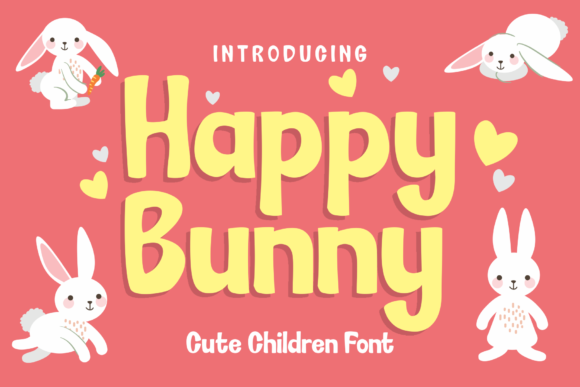
There’s a moment—right after you’ve sketched your idea for a set of printable birthday party banners—that you pause and ask yourself: Does this feel joyful enough? That’s when I reached for Happy Bunny. Not as a last-minute add-on, but as the first intentional choice. This Display font didn’t just sit on my design—it bounced in, tilted its letters with quiet confidence, and made everything around it feel lighter, warmer, more genuinely human. As a maker who designs printable wall art, boutique gift tags, and seasonal sticker sheets, I need fonts that hold up at 12pt on a mini favor tag and shine at 120pt across a farmhouse-style chalkboard sign. Happy Bunny does both—not because it’s flashy, but because it’s thoughtfully chunky, friendly, and unapologetically playful.
Happy Bunny for Children Activity Printables and School Project Templates
I recently updated my collection of editable school project templates—think science fair display boards, reading log covers, and classroom job charts—and swapped in Happy Bunny for all titles and section headers. Why? Because Happy Bunny is a cute and fun display font that immediately signals “this is for kids, not committees.” Its rounded terminals and generous x-height make it highly legible even when printed on copy paper or cut with a Cricut Joy. I tested it at 18pt on a laminated “Classroom Helper” badge—no pixelation, no thin strokes collapsing. Since Happy Bunny is designed as a Display font, it’s not meant for body text—but that’s perfect. It draws attention where it should: to names, themes, and joyful declarations like “My Dinosaur Report!” or “Summer Reading Challenge.” For digital downloads, I pair it with a clean sans serif (like Montserrat Light) for instructions and captions—keeping contrast high and tone consistent.
Happy Bunny for Greeting Cards and Handmade Stationery
Last month, I designed a small batch of hand-lettered-style greeting cards for birthdays and “just because” moments. Instead of tracing my own script—which takes time and doesn’t scale—I opened Happy Bunny and typed “You Make My Day!” in one click. The natural rhythm of its letterforms gave me instant charm: the lowercase b and y have subtle bounce, the g curls just right, and the spacing feels handmade, not mechanical. As a Fonts user who prints on textured cardstock, I appreciate how its thick strokes hold ink beautifully—even on matte finishes. No fading, no fragile serifs to break. When paired with a soft-script companion font for signatures or flourishes, Happy Bunny becomes the cheerful anchor. And yes—it’s fully compatible with Silhouette Studio and Cricut Design Space. I exported SVGs straight from Glyphs, checked kerning manually on key phrases (“Best Friend,” “Little One”), and cut flawless vinyl decals for card fronts.
Happy Bunny for Boutique Packaging and Product Labels
If you’ve ever held a candle labeled with tight, overworked script—or worse, a generic bold sans—you know how much tone matters in packaging. That’s why I used Happy Bunny for a new line of soy wax melts named after childhood memories: “Lemonade Stand,” “Treehouse Key,” “Rainbow Puddle.” Printed on kraft sticker paper at 24pt, the font’s chunky weight gave each label presence without shouting. Its authenticity shines through—no forced whimsy, no cartoonish exaggeration. Just warmth, clarity, and a quiet nod to nostalgia. As a Display font, Happy Bunny works best for short bursts: product names, scent descriptors, and playful icons (I added a simple bunny outline beside the name—no extra graphics needed). Before final print, I always check the included OTF files for basic OpenType features—standard ligatures and alternate characters—and found two delightful lowercase a options that added subtle variety across labels.
Happy Bunny for Printable Wall Art and Digital Download Previews
When designing digital wall art for nurseries and playrooms, readability at thumbnail size is non-negotiable. Happy Bunny delivers: its generous counters and open apertures keep letters distinct even in Etsy listing previews or Instagram story teasers. I created a set of “First Words” posters—“Hello,” “Yes,” “More,” “All Done”—all in Happy Bunny, sized to fill an 8x10” frame. On screen, they pop. In person, they invite touch. Because Happy Bunny is a cute and fun display font, it avoids looking clinical or cold—a common pitfall with many modern kids’ fonts. For commercial use, I confirmed the license covers digital downloads, physical prints, and resale of finished products (no attribution required), which matters when bundling these as part of a larger planner pack or classroom resource.
Happy Bunny for Wedding Welcome Signs and Elegant Branding
Yes—Happy Bunny belongs at weddings too. Not for formal invitations (save those for a refined serif), but for welcome boards, dessert table signs, and custom tote bags handed to guests. Think “Welcome to Our Tiny Celebration” or “Bunny & Bear’s Big Day” written in Happy Bunny, then foil-stamped on ivory linen. Its authenticity makes it feel personal, not mass-produced. As a Fonts creator who designs for real couples—not stock photos—I love how it balances charm with sophistication. Paired with a delicate handwritten font for names and dates, Happy Bunny adds grounded joy. And because it’s a true Display typeface, it scales cleanly from 36pt on a 24x36” foam board down to 14pt on a mini chalkboard menu—no blurring, no awkward compression.
Happy Bunny for Stickers, Tote Bags, and Seasonal Craft Designs
My latest sticker sheet—featuring “Good Job!”, “Snack Time”, and “Adventure Awaits”—relies entirely on Happy Bunny for impact. At 10–12mm tall, its sturdy strokes remain crisp when die-cut, and its personality survives scaling down. Same goes for fabric-printed tote bags: I ran a test print of “Happy Bunny Loves Books” across a natural cotton canvas, and the font’s weight translated perfectly—no ghosting, no thin-line breakage. Whether you’re making holiday gift tags, spring-themed planner stickers, or summer camp water bottles, Happy Bunny brings consistency and heart. Just remember: it’s a Display font, so reserve it for headlines, names, and short affirmations—not paragraphs. And always preview in your intended format: PDF for print, PNG for web, SVG for cutting machines.